

|
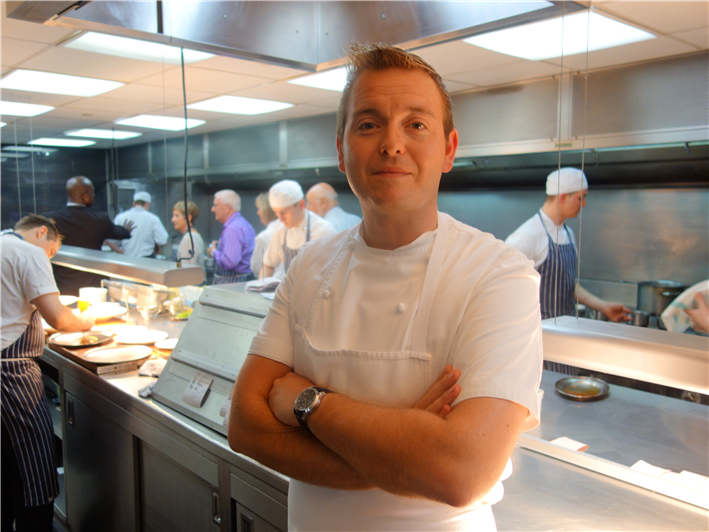
Maze is part of the Gordon Ramsay empire, its head chef currently Tristin Farmer. The notes below are from when Jason Atherton was in charge; he has since gone his own way with Pollen Street Social.
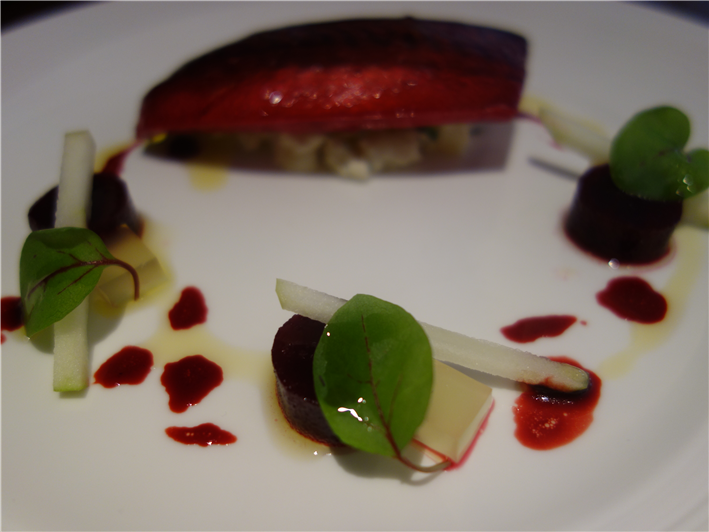
Maze seems as successful as ever, packed out early this evening. We tried a wide range of the dishes this evening. Crab salad with pickled mooli, apple jelly and Bloody Mary sorbet had excellent crab, and the taste combination was refreshing. A pair of roasted scallops was served with a classical pairing of cauliflower puree, and a muscatel vinegar dressing to give a little acidity to balance the sweet scallops. Honey and soy roasted quail had good flavour, served with a little foie gras from Landes and a spiced pear chutney.
Roast squab and Peking duck leg was served on a wooden chopping board with marinated turnip and date sauce. Roasted organic Shetland cod tasted excellent and was attractively paired with crispy pigs trotters, tripe and ears, along with some broad beans and peas. Cornish red mullet tasted fresh, with sardine and saffron rice, Pimento pepper puree and “paella air”. A rare breed Suessex pork was served “head to toe” with parsnip and spiced lentils. There was also a Cornish crab mayonnaise with avocado, sweet corn sorbet and Oscietra caviar, another dish whose flavour combinations worked well. All these dishes hovered around the 6/10 level.
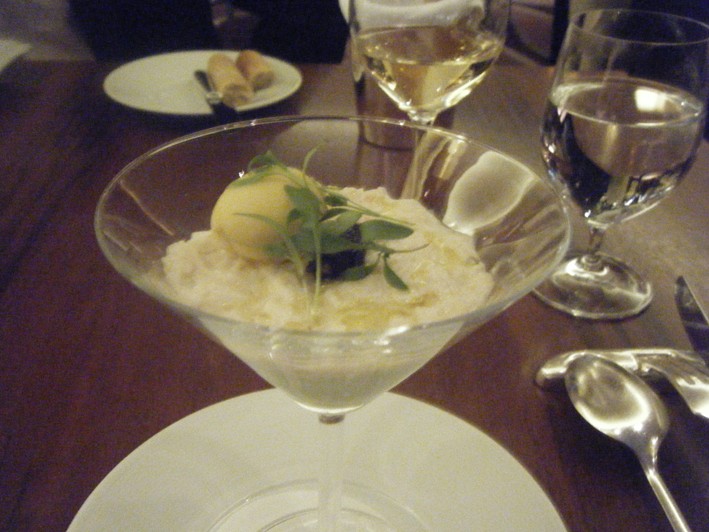
The star of the evening for me was the BLT and Croque Monsieur pairing that will be familiar to those who have watched the 2008 Great British Menu TV series (this was the winning starter). This witty dish reinvents these sandwiches, the BLT arriving in a cocktail glass, with a lettuce soup in a glass on the side, the main cocktail glass holding tomato jelly, bacon onion cream, the dish garnished with fried onion rings and bacon lardons. This was a wonderfully successful combination of refreshing flavours (8/10). The brioche croque monsieur was less interesting for me, but the BLT was inspired cooking; the great thing was the flavours were so intense and complimentary; this was not just a dish relying on originality, but actually tasting great.
The wine list at Maze is excellent, with attractive choices from all around the world, at just about tolerable mark-ups. Service was excellent, though quite why the staff find it necessary to dim the lights to the point of gloominess shortly after the evening began eludes me: this is an attractive room with pretty food, and it would be nice to be able to actually see it.
Below are notes from a meal in January 2007, by way of comparison.
Here are notes on my most recent dinner at Maze. One oddity here is a fetish about peculiar cutlery. On the table are little stands into which a knife, form and spoon (barely) rest their sharp ends (if you see what I mean). The waiters must just hate these because requires the skill of a juggler to replace the cutlery into these utterly pointless stands once you have removed them to, for example, actually eat something. Hence in between each little tapas dish there was a cameo of me trying to putt my fork prongs into the little holes in this stand, failing and having the fork roll around the table, after which a waitress would have a go, admittedly usually with more success than me (perhaps they have training classes). Sometimes cutlery is replaced between courses, sometimes not; perhaps there is some sort of unwritten code for how much in the way of sauce or food fragments must be left over to justify a replacement. All in all I found this a pretty tiresome distraction from the food.
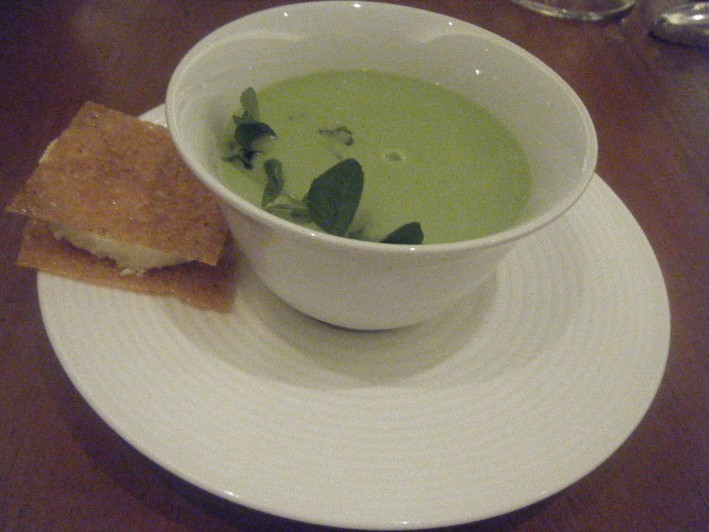
The meal started well with Jersusalem artichoke, poured at the table into a cup with a little duck ragout. On the side was a small cep brioche with cep butter. The duck ragout had excellent strong taste and the artichoke soup also had good flavour, fluffed up with a whisk a little before serving; I don’t think the cep brioche added anything (7/10). Next was an aberration: “native lobster” served with thin slices of turnip and a few tiny pickled girolles, served with an aigre doux (sweet and sour) dressing and seasoned with ginger salt. The “native lobster” was very chewy indeed, so much so that I sent it back. Worryingly, when the dish came back it was identical, yet it could hardly be cut with my knife; maybe a super-sharp Japanese chef’s knife would have done the trick, but you get the idea. The turnip would have balanced the lobster reasonably well, along with the sweet and sour dressing, but that supposes you could actually eat the lobster (0/10). The meal came back on the rails next with three lovely Orkney scallops, very tender having been roasted with spices (all spice was involved) and a peppered golden raisin puree, while one scallop rested on a little cauliflower puree (7/10).
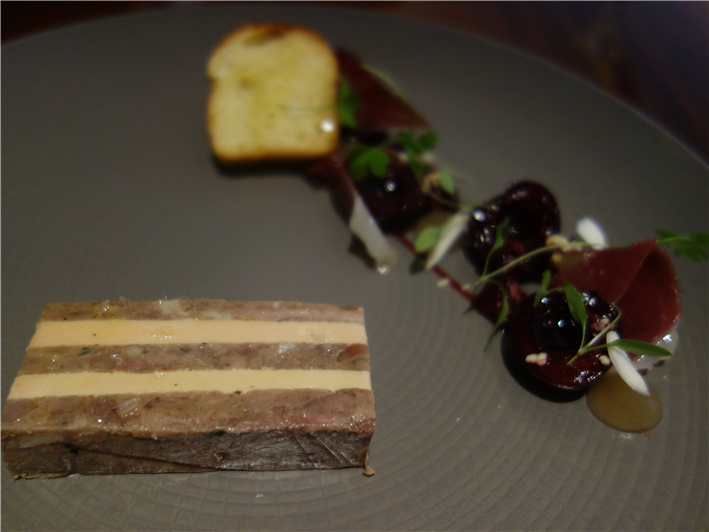
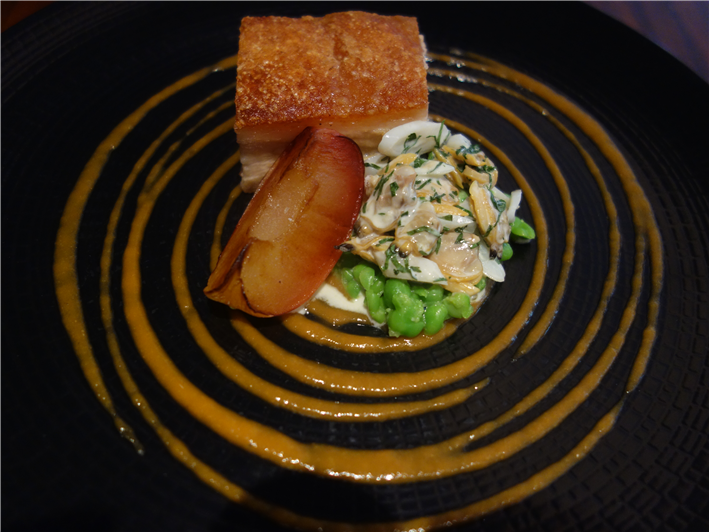
Honey and soy roasted quail was very tender, served as two pieces with a little foie gras from Landes and a spiced quince chutney that seemed superfluous (6/10). Spiced Royal Berkshire pork belly (cooked for 24 hours) was tender, served with an excellent piece of fillet of pork hat had been cooked sous vide at just 55C for just under an hour; this technique worked really well here, the pork being moist and full of flavour. This was served with apple cardamom puree and a jasmine-flavoured reduction of the cooking juices. There was an unannounced little mash potato that was so creamy it was almost liquid, which I think would have been better in a more conventional solid state (7/10 for the pork if I ignore the odd potato). Bread was just two rolls: white and brown (5/10).
The wine list is extensive and has a perfectly reasonable idea of a “flight” of three wines. What is weird is that they deliver these (a mix of white and red in this case) on a little rack, the glasses hanging on the rack rather like those little hangers they have at buffets so you can hold a plate and a wine glass with one hand. This is a peculiar idea, since surely you want the wine to be served when it is appropriate, and at the right temperature. We skipped dessert (which had a lot of rather odd combinations, with nothing classical at all except sorbets) and then asked for the bill. This was a bit of a farce, as first the bill arrived with the lobster still on it (which I had not eaten) and then reappeared minus lobster but plus a mystery £52 bottle of wine. Third time lucky in the end. The meal had some high points e.g. the excellent soup and pork, and the lobster was hopefully just out of character. My wife’s dishes were generally 6/10 level except for a bland potato salad, so I think the 6/10 mark is just about OK
What follows, by comparison, is a meal soon after it opened.
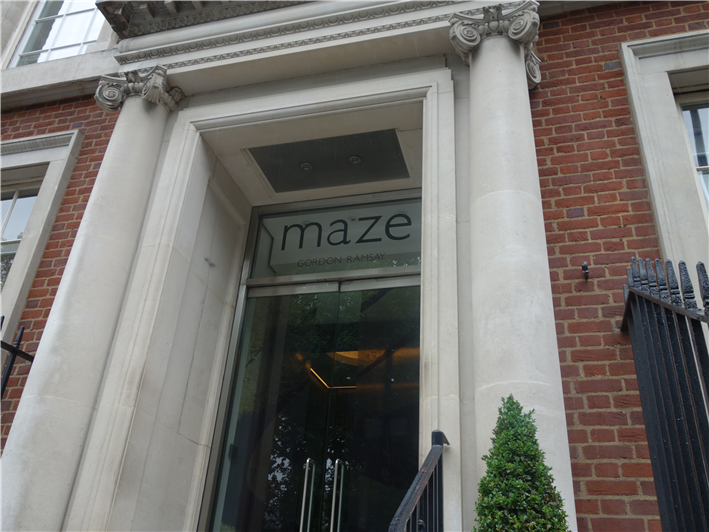
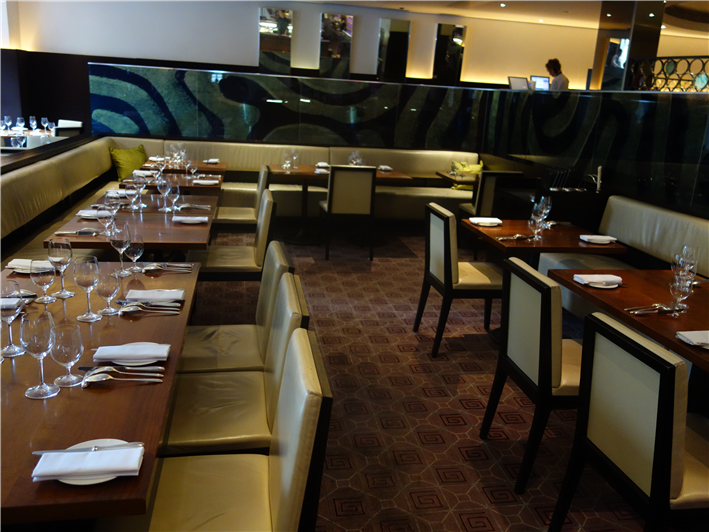
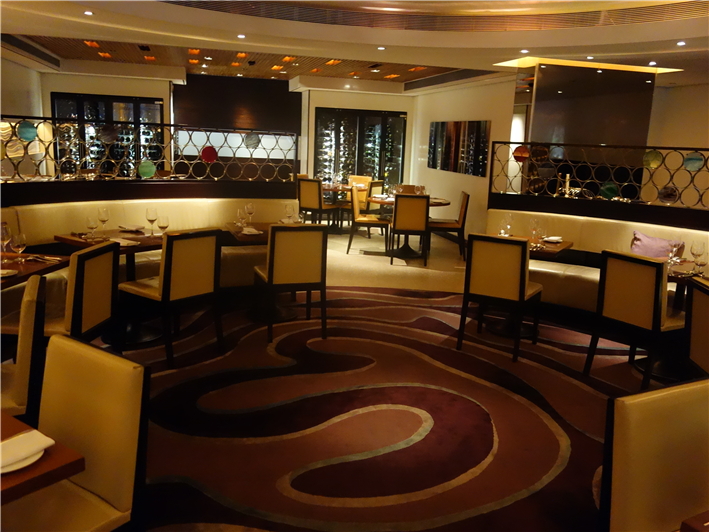
You enter up a small flight of steps to the restaurant from Grosvenor Square. After passing the welcome desk you walk into an L shaped room. On the right is a substantial bar, on the left various chairs and sofas, and it seems that you can also dine at the bar. The dining room stretches beyond and to the right. The flooring is wood, though there are a couple of carpeted stretches. The décor is unfussy, with plain white walls and ceiling, with no paintings or adornments at all on the walls. The ceiling is quite low, with overhead spots carefully directed and producing a good level of light to the tables. The upholstery is cream, with low modern chairs and also several runs of banquette seating, also with cream upholstery. Tables have no tablecloths, but there are white linen napkins. The room’s designer is David Rockwell, an American architect. Overall the feel is modern and informal, and they have done a good job with a rather awkward L-shaped space with a low ceiling. Pop music plays in the background, quietly initially though a little louder later on.
Crockery is plain white Limoges china, and wine glasses are Riedel. Waiters are dressed in black trousers and light brown shirts with no ties. Even four weeks after opening, service was very slick, with food arriving at a regular pace, wine and water topped up, and no trouble getting attention. The maitre d’ is one of those “guest” ones who opens restaurants (recently seen at Pengellys) while the head waitress was formerly at Mossimans. Chef Jason Atherton was chef at the excellent Verre, Gordon Ramsay’s Dubai venture. I went there two years ago and scored the meal there 8/10, so this is someone who can cook. Maze is already a success, with 90 covers at lunch a day (for a place seating 80) and they have already had a 150 cover evening. Not bad for four weeks in operation.
The menu is ambitious. It must be a lot of work in the kitchen, as there is an a la carte as well as the primary tapas style, with about 6-8 dishes per person the advice from the waiter. One feature I found rather odd was that your knife and fork are retained between dishes (until the main course stage) and a little silver rest is provided for this. This seems to me to be taking the informality too far – I don’t like having to eat a course with tastes left over from the previous course; I think they charge enough here to be able to afford fresh cutlery with each course. The menu is full of appealing dishes, though what is strange is that the dessert menu suddenly switches into El Bulli territory (where Jason spent a short stint) with a set of bizarre ingredient combinations without a single dessert that would be considered classical. This seems odd given the pleasant and wide choice for earlier courses. Peanut butter and cheery sandwich is one of the desserts, to give you an idea, and this was one of the saner choices.
The wine list runs to 16 pages, and there was a helpful and knowledgeable Hungarian sommelier to guide you through. The list covers the globe, with choices from Chile and even Greece as well as the usual classics. JJ Prum Kabinett 2002 was a fair £42, while Mas de Daumas Gassac white 2000 was £58, to give an indication. There are a number of choices under £30, though virtually nothing under £20 that I noticed. At the other end of the scale, Vega Sicilia Unico 1962 was £840, and there were some even costlier French classics for those for whom mark up is no object. Bread comes in just two varieties: a cylindrical white roll, and a similar granary one, which looked home-made. The bread is well-seasoned and has reasonable taste and texture, but was not from the top drawer (5/10).
Tuna carpaccio was served as five discs of very thin tuna, alongside five discs of marinated daikon (Japanese radish), each topped with a little viola flower, served with a little olive paste. The tuna seemed of good quality, though sliced so fine that limited taste could come through (4/10). I am not sure that the flowers really added anything other than colour. Scottish lobster was of the non-chewy variety, served with a little good quality green asparagus, fennel shoots and an “aigre doux” i.e. sweet and sour dressing that was fairly well balanced (4/10). Artichoke salad had shredded leaves and a pleasant dressing along with a few slices of summer truffle, with artichokes that in themselves had rather ordinary flavour (4/10).
Two Orkney scallops were roasted with spices and served with a little delicate cauliflower puree and a peppered golden raisin puree. The scallops were of high quality and correctly timed, the spices adding a hint of interest without dominating the subtle taste of the scallops, while the raison puree was a nice counterpoint to the sweetness of the scallops (7/10).
Monkfish tempura was served on a salad of strips of Granny Smith apple and endive, the tempura quite delicate and the fish cooked through properly, offered with a mild mango and chilli dressing. Though the components were pleasant, I didn’t think they worked very well together as a combination (5/10). Piquillo red peppers encased a brandade of morue (a rather tasteless salt cod) alongside new season garlic puree and garlic chips (4/10).
Risotto of carnaroli with peas, broad beans and wood sorrel worked very well, the flavour of the peas coming through strongly and the risotto working very well with the carnaroli rice (used in Piedmont and Lombardy instead of Arborio rice) giving a creamy texture to the risotto, which was topped by a little summer truffle – definitely not the “white truffle” announced by the waiter (7/10). Honey and soy roasted quail was tender and pink inside, served with a sliver of silky warm Landes foie gras, alongside a chutney of peach and saffron (6/10). The main course was a wild sea bass, fresh and nicely timed, with good flavour. This was served with a little asparagus, a smear of tomato and lemon grass nage, and candied aubergine and a little caviar as garnish (6/10).
My main course was squab cooked in a wood-fired oven, tender and pink and served on the bone. This was served with celeriac cooked with spices, a puree of spring cabbage and an unusual idea, a “sandwich” of bacon and dates, the dates resting between two slices of bacon. I thought that the flavours here worked well together, and the squab itself was of high quality (7/10).
Cheese is from La Fromagerie, a popular source for London restaurants. Manchega was as hard as rock – I literally could not cut it with the knife provided. A British goat’s cheese was pleasant, as was Forme d’Ambert and Cornish Yarg that was not quite yet at its best, but Epoisses was unripe. I really don’t know why restaurants in London are incapable of producing a good cheeseboard. I can literally buy better condition cheese from the delicatessen at the end of my road, as I did the following day. The deli gets their cheese from Neal’s Yard and a French supplier i.e. there is no magic here, so if he can do it, why can’t the top restaurants in London? In this case Maze didn’t even have a large board, but were selecting a few cheeses, so were in a position to pick the cheeses in best condition, so there is no excuse whatever here.
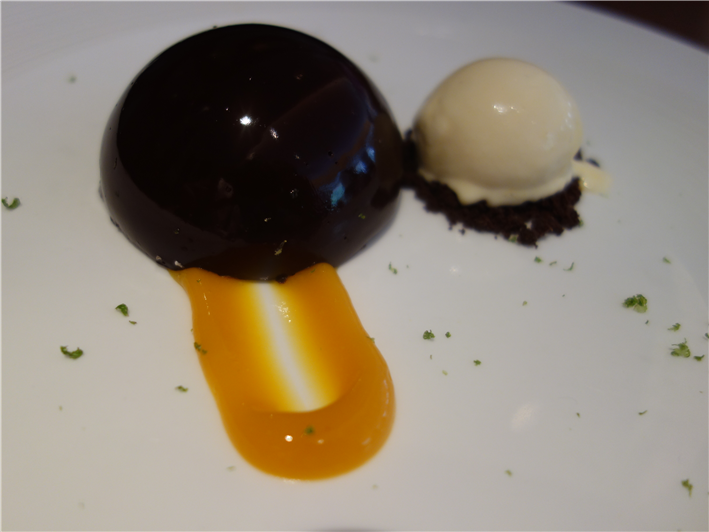
For dessert a chocolate fondant produced a rare technical error tonight, the fondant being much too runny in the centre, though as it was made from Valrhona chocolate it still tasted pleasant enough, served with a sea salt and almond ice cream, which was as pointless and bizarre to taste as it sounds (3/10). A passion fruit and rhubarb trifle was topped with an excellent granite and served with two high quality Madelaines (5/10). Both filter coffee and espresso (a decent sized portion) were very good (6/10). These came with a Turkish delight, a pleasant hazelnut chocolate and a terrible idea – a lapsang souchon tea flavoured chocolate, which tasted vile.
I like the tapas idea – it works well at Atelier Robuchon in Paris (Jason worked for three weeks there prior to opening to learn about the tapas approach), and indeed also at Club Gascon in London. The kitchen here seems capable of delivering courses at a steady pace, and there were no major technical errors in the dishes served. Ingredients were of sound quality e.g. the Orkney scallops and the tasty squab. There was a general tentativeness with seasoning, and the dessert menu seemed incongruous with the rest of the menu. However these are fairly minor quibbles. I think the kitchen can step up a gear beyond its current level, and I know that this chef is capable of better. For now, 5/10 is the correct mark, but there is potential for a higher mark here in the future. |